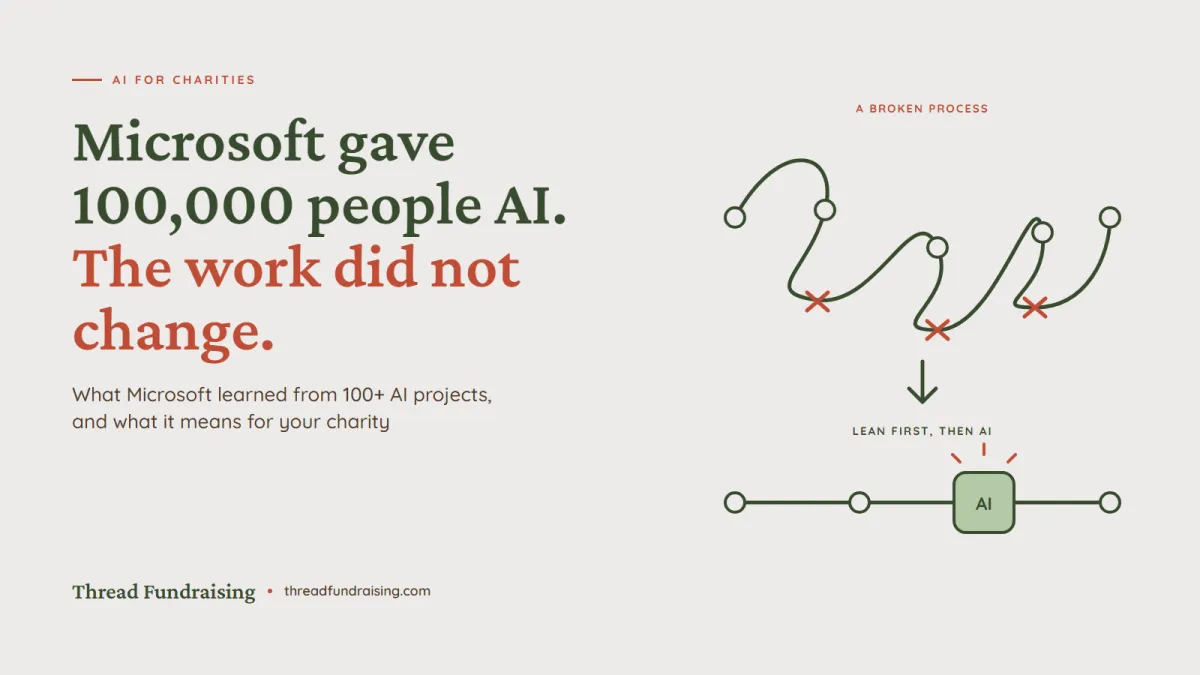
Microsoft gave 100,000 people AI. The work did not change.
"A tool licensed and rolled out to 100,000 employees does not change how the work gets done."
That's what Microsoft themselves announced last week. The company published a 44-page playbook, Becoming a Frontier Firm, built from a review of more than 100 of its own internal AI projects. Kathleen Hogan, who leads its transformation work, set out the lessons in a blog post on 17 September.
The company that sells Copilot is telling you that buying Copilot is not enough.
At Thread we said something similar last year.
Most charities we work with are at the same point Microsoft describes. Nearly everyone uses AI now, and very little has changed about how the work gets done.
So many teams are limited to Copilot (the cheapest version) and are given no guidance on how to use it or how it might help them, so it becomes a glorified copywriter or research assistant.
Last week I wrote about Mark Ajzenstadt's lessons on putting AI into real organisations. Microsoft's playbook reaches many of the same conclusions, with much bigger numbers behind them.
What worked for Microsoft
So if licences did not work, what did? Microsoft's answer is the order you do things in.
Fix the process first, then add the AI. Microsoft calls this "lean before agents". Its cloud supply chain team mapped every step of its planning work and cut the waste out. It built one shared source of data. Only then did it add AI, 111 small AI tools (Microsoft calls them agents) doing specific jobs. Planning that took about 10 working days now takes under two and a half. Hogan's version is the line I would put on every charity's wall: "Adding agents to a broken process still leaves a broken process."
Start with a role, not a tool. Microsoft stopped telling people to "use AI more". Instead it picked one role, its sellers, and mapped their week. Where did time go? Which tasks did they hate? Then it showed them where AI fitted into those exact moments. In the pilot group, close rates went up 20% and revenue per seller went up 9.4%. The gap between keen users and everyone else, the playbook says, "is rarely access". It is whether people can see what AI does for their own job.
Managers set the pace. When managers used AI themselves, in front of their teams, the value people reported went up 17 points and trust in AI went up 30 points. Managers who handed AI to the team and stepped back "do not move their organizations".
Small groups beat big training sessions. Microsoft's sellers now meet weekly in small groups by role. A colleague who is good with AI leads each one. People see a peer use AI on work they recognise, and they copy it. The playbook calls this a permanent part of how the team works, not a one-off course.
Write down what good looks like. Every organisation has its own way of doing things. Generic AI does not know it. Microsoft's advice is to write your standards down as a set of test examples, so AI output can be checked against them. Its Copilot lead, Charles Lamanna, puts it simply: "If you don't define what 'good' looks like, AI defaults to something generic."
Be patient about results, and honest about the timeline. Microsoft measures in four layers. Use of the tools shows up in two to four weeks. Real change to the work shows up in one to three months. Better performance takes three to six months, and business results take six months or more. Its test is a useful one: if lots of people use the tools but the work has not changed after three to six months, you have a habits problem, not a tools problem.
But you are not Microsoft
Microsoft set up a transformation office in every division. Most charities have a fundraising team of four and a database manager who is also the IT department (if they are lucky!). So does any of this apply?
Mark Ajzenstadt answered that question in a post about the playbook. He runs Limestone Digital, which puts AI into mid-sized companies owned by private equity funds. He sees the same failure on most first calls. One firm gave an AI assistant to 20 people. Two of them built something, and the finance director called the result "very brittle".
His point is that a small organisation does not need Microsoft's scale. It needs three things: one team, one champion and one workflow. The champion is someone inside the organisation who owns the AI tool. They are trusted before any consultant arrives, and they are still there after the consultant leaves. Without that person, Mark says, the team drifts back to the old way.
His order of work is five steps, and I would not change a word of it for a charity:
- Simplify the workflow.
- Define what correct looks like.
- Make it reliable.
- Embed it with your champion.
- Scale up from what you measured, not what you hoped.
Mark says this can reach proof that it works in the first month. We've seen the same with our AI voice assistant and AI email agents. A small team to implement, a champion who understands the process, and then share the learnings across the team and wider charity. You then normally find pockets of curious people who want to give AI a go themselves.
What this means for your charity
Here is how I would use Microsoft's lessons in a charity fundraising team.
1. Map one process on paper before you buy anything. Pick one that supporters notice, such as thank-you letters that take three weeks or Gift Aid declarations chased by email. Draw every step and every handoff. You will find steps that exist only because they always have. Take those out first. That work pays off even if you never add AI.
2. Pick one role and map their week. Do not run an "AI for everyone" session. Sit with your supporter care officer or your individual giving manager. Where does their time go? What do they dread on a Monday? Fit AI to those moments and show them how, on their own work.
3. Start with your managers. If the head of fundraising never uses AI in front of the team, the team will not use it either. Microsoft's 17-point and 30-point figures come from managers who showed their teams how they used it. Train managers first, not last.
4. Write down what good looks like. For a charity, this is your tone of voice, your case for support and your rules on supporter care. Collect 20 or 30 real examples of good thank-you letters or good replies to supporters. That set becomes the test every AI draft has to pass. Also write down where AI must never act alone: vulnerable supporters, complaints and gifts in wills are good places to start.
5. Tell your trustees the real timeline. Use of the tools will show up within a month. Money raised will not move for six months or more. If you say that at the start, a slow first quarter looks like the plan, not a failure.
One more thing from the playbook is worth saying to charities in particular. Microsoft warns against using AI to get rid of junior roles. If AI does all the entry-level work, nobody learns the craft, and in five years you have no senior fundraisers. Microsoft pairs juniors and seniors. The senior teaches the craft and the junior teaches the AI. A small fundraising team could do the same tomorrow.
Where to start
Microsoft needed more than 100 projects to learn this. You can skip most of them. Choose the one process your supporters would thank you for fixing, and find the person on your team who will own it. Map it, simplify it and write down what good looks like. Only then ask whether AI can make it better.
If you would like help choosing that first workflow, our team of consultants can help. Get in touch if you'd like to have a chat, or for us to conduct an audit for you to discover your best opportunities to improve your processes.
The playbook and figures are Microsoft's, from Becoming a Frontier Firm and Kathleen Hogan's blog post (September 2026). The small-organisation reading is Mark Ajzenstadt's, from his post on X. The charity translation is ours.