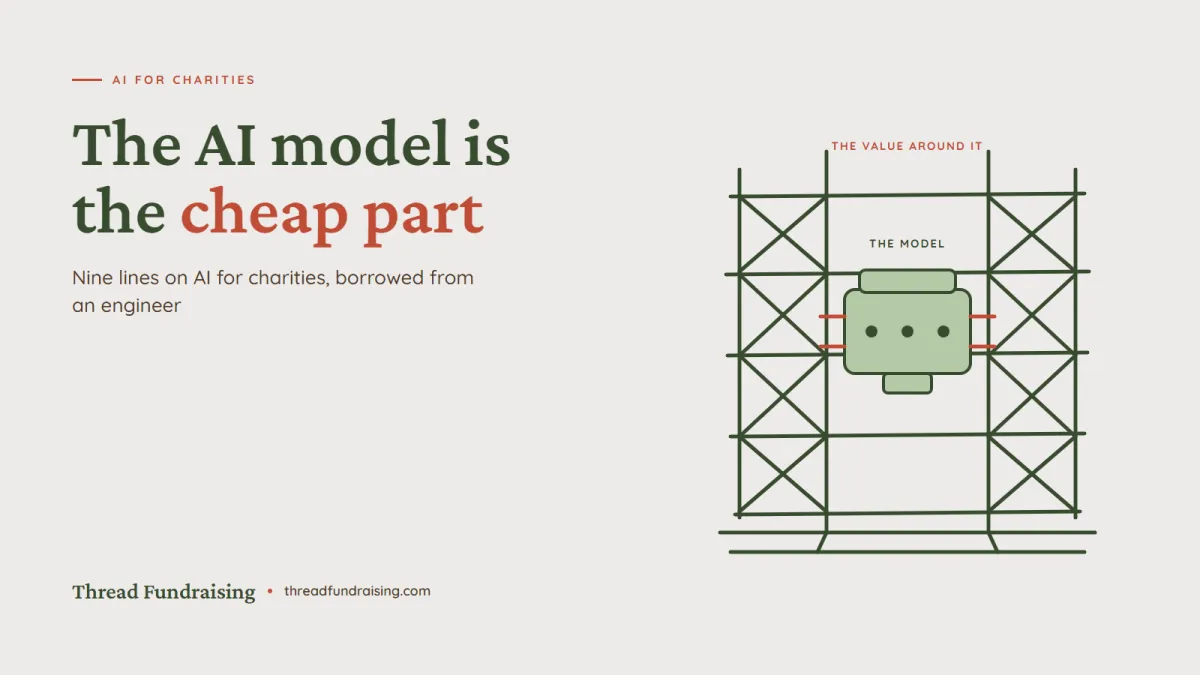
The AI model is the cheap part
A charity director told me last month that her team "has AI now". They have Copilot. Twenty people use it. It writes their emails and tidies their meeting notes.
Then I asked what had changed about how it had helped improve their supporter care or how it had solved a process headache. Nothing had. Same handoffs. Same spreadsheets. Same two people who know how it all works, and one of them is off on Fridays.
That is not a criticism of her. It is where almost every organisation is, charity or not. I know because I have spent the last week reading everything Mark Ajzenstadt has written about it.
Who he is
Mark runs Limestone Digital, a 200-person engineering firm that puts AI into companies owned by private equity funds. Healthcare billing, lending, logistics. Not our world. His clients care about profit before a sale. Ours care about income for the cause and delivering for our beneficiaries.
But he thinks more clearly about how to put AI into a real organisation than anyone I have read in the charity sector, and his lessons translate almost word for word. So I have borrowed them, with credit, and written them the way I would say them to a chief executive or fundraising director.
Nine lines, borrowed and translated
1. The AI model is the cheap part. The scaffolding around it is the value. Mark calls it the harness. The written-down process, the rules that must never vary, the test that says whether the answer is right, and the person who signs it off. Change the model underneath and nothing should break.
2. Buying AI seats is adoption. Rebuilding how work moves is transformation. His line: "work still moves through your company along the same path it took in 2023." Copilot on every desk does not change the path.
3. One workflow. Real users. A number you already track. This month. Not a roadmap. Not a maturity assessment. Pick the process that burns the most hours, or the one supporters complain about, and fix that one first.
4. Write the process down before you automate it. Most of it lives in two people's heads and a shared spreadsheet. Mark's teams spend their first week writing zero code and documenting everything. He says four days of writing saved four months of rework. For a charity, those documents double as the induction pack you never had time to write.
5. Measure against the baseline, in operating terms. Hours saved are not cash until cash is saved. Thank-you turnaround, cost per pound raised, second-gift rate. Write the number down before you start, or you will end up with "it feels faster", and no accurate numbers to see if it is worthwhile.
6. Anything with a known right answer stays in fixed rules, not in the AI. Gift Aid eligibility. Whether a direct debit bounced. The salutation on a letter. These are arithmetic and lookups, and the AI should never be guessing at them.
7. The AI proposes. A named person decides. Anything that reaches a supporter, a regulator or the bank waits for a human. And that human has to stay awake. Anthropic's own data shows reviewers approve 97% of what an AI asks after fifty prompts. The checking has to live in the system, not in a tired person clicking yes.
8. Change management is not a line item. It is the rollout. Mark has watched working tools sit unused for months because nobody spent two weeks on adoption. "If nobody in the operation touches it on a Tuesday, it's a science project." For a team of four, that fortnight of learning and understanding is the whole difference.
9. Build it so they need you less every quarter. This is the one I wanted to steal most. Mark's firm bills month to month, and every engagement has fewer people on it at the end than at the start, by design. That has been Thread's ethos since the beginning: we train, we improve, and the aim is that you do not need us. Most clients still want the support. That is fine. But the design intent should be independence, not dependence.
The one that matters most for charities
If I had to pick one, it is number five. Charities are told to be cautious about AI, and rightly. The honest way to be cautious is not to avoid it. It is to decide what "correct" looks like before you build, and then check.
Data processing and analysis. Coding. Clean data. These all have right answers, so they are the place to start.
Where to start
Pick the one supporter or beneficiary process that people complain about, wait on, or leave over. Slow thank-yous. Unanswered queries. Not responding to volunteers for weeks. Map how it works today, on paper. Write the baseline down. Then, and only then, ask whether AI would make that one interaction better.
That is one workflow. It is the whole job.
All of these principles are Mark Ajzenstadt's, from his posts on X in August and September 2026. The charity translation is ours.
If you want help finding that first workflow, our AI for charities page explains how we do it.